

Books and Book Chapters
The Digital Life of Grief, edited by Dr Katrin Gerber, Distinguished Professor Larissa Hjorth and Professor Crystal Abidin, explores online mourning in the age of hashtags, algorithms, and social media. From TikTok memorials to grief influencers to the politicisation of loss, this collection asks how platforms affect whose grief is amplified and whose is erased. Drawing on digital ethnography, visual analysis, and platform critique, this Routledge book shows how the design of mobile media shapes the way we mourn. Essential reading across media studies, death studies, sociology, anthropology, and psychology. Order a hard copy here or freely view the online version via the open access tab: https://www.routledge.com/The-Digital-Life-of-Grief-Online-Mourning-in-the-Age-of-Hashtags-Algorithms-and-Social-Media/Gerber-Hjorth-Abidin/p/book/9781041195399

Distinguished Professor Larissa Hjorth's 2025 MIT Press Book 'Mourning on Mobile Media' offers a timely look at how mobile-device rituals—from Instagram eulogies to TikTok reactions to global disasters—shape the way we mourn, remember and connect in an age of crisis and constant mediation. It can be freely accessed here via the open access tab: https://mitpress.mit.edu/9780262553551/mourning-on-mobile-media/
Read a book review about 'Mourning on Mobile Media' by Lauren Fukushima published in the International Journal of Communication (2026) here: https://ijoc.org/index.php/ijoc/article/download/28034/5420

Explore our chapter in the new book Decolonising Death Studies (Routledge, 2026), edited by Panagiotis Pentaris, Stacey Pitsillides and Hajar Ghorbani—a global, interdisciplinary rethinking of death studies beyond Western frames. In our chapter, “Grief at the End of the Anthropocene: Climate Emergency, Loss, and Eco-Grief” (Borovica, Gerber, Hjorth, 2026), we explore how climate breakdown is reshaping experiences of loss and mourning. https://www.routledge.com/Decolonising-Death-Studies/Pentaris-Pitsillides-Ghorbani/p/book/9781032878553
Journal Publications
In this 2026 paper, our team including Jed Brubaker, Tamara Borovica, Katrin Gerber, Caitlin McGrane and Larissa Hjorth explore how AI might reshape grief and memorialisation beyond simply imitating the dead. Drawing on a speculative design workshop, the paper examines new memorial practices, continuing bonds with the dead, posthumous data, and the challenges of sustaining grief technologies. Read Speculating the Afterlife in Thanatos: https://journal.fi/thanatos/article/view/162347/127225
In this 2026 Death Studies paper, our very own Larissa Hjorth joins grief experts Melissa Lunardini, Chris Hall, Phyllis Kosminsky, Val Massdorp and Andy Hau Yan Ho as part of the International Work Group on Death, Dying and Bereavement to set out principles for responsible AI use in grief care. The paper defines "Grief AI", sorts applications by risk, and weighs the ethical tensions this raises. Read Assumptions and principles for responsible AI development and use in grief and bereavement care in Death Studies: https://www.tandfonline.com/doi/full/10.1080/07481187.2026.2721402
Our paper in Social Media + Society explores why some people decide not to share their grief online. We are discussing what our research participants could and could not be shared and why non-sharing is sometimes a deliberate choice in grief. The paper is freely accessible here: https://journals.sagepub.com/doi/full/10.1177/20563051261430718 [Reference: Borovica, T., Gerber, K., & Hjorth, L. (2026). Unshareable: Non-Sharing Grief and Grievabilities on Social Media. Social Media+ Society, 12(1)]
Media
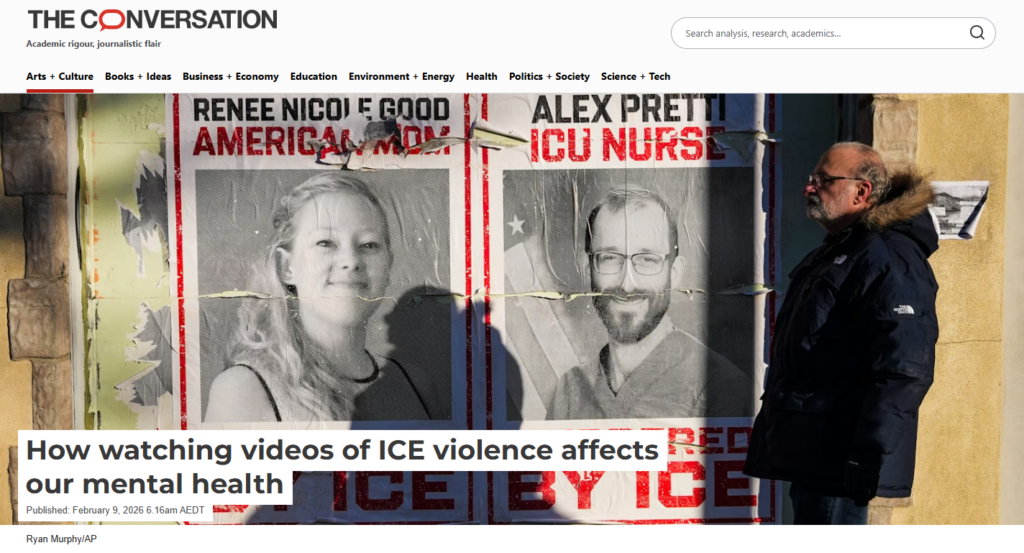
Why do some deaths travel the world — and stay with us — while others barely register? In our article for The Conversation (Hjorth, Gerber, 2026), we explore how mobile phone footage turns ordinary viewers into witnesses to political grief, collapsing the distance between “them” and “us”. We argue that what we see on our phones doesn’t just inform us — it stays in our bodies, shapes public mourning and raises urgent questions about what we do with what we can’t unsee. Read more here: https://theconversation.com/how-watching-videos-of-ice-violence-affects-our-mental-health-275217
ABC Townsville Radio Interview with Dr Katrin Gerber about the mental health effects of watching violent news online (Host: Adam Stephen - 9.2.26)
CC2 Canberra Radio Interview with Dist Prof Larissa Hjorth about witnessing graphic content on social media (Host: Stephen Cenatiempo - 10.2.26)
RTRFM Perth Radio Interview with Dist Prof Larissa Hjorth about mobile media, collective mourning and witnessing of grief
SBS Examines Podcast with Dist Prof Larissa Hjorth and others about how in a polarised and digital world grief can unite us (Host: Lera Shvets - 7.4.26)
Resources
These resources are free to use and share but please attribute Distinguished Professor Larissa Hjorth as the Copyright holder.
The Mourning After Exhibition Catalogue - A compact companion to The Mourning After Exhibition, this catalogue holds participating artists’ short, reflective essays that discuss how their works approach grief as a shared social practice. From intimate losses to ecological and political mourning, the pieces invite readers into methods, materials and moments of care and conversation.
The Mourning After Exhibition Card Set - A playful prompt deck created by The Mourning After workshop facilitators, offering gentle provocations to explore, experience and express many kinds of grief—from bereavement to ecological and collective loss. Use the cards solo or in groups to spark conversation, try small creative exercises and make space for reflection and connection.